Part of the Hotel GM Picks: Spain editorial series.
The Gaudí Question
Every conversation about Barcelona eventually arrives at Antoni Gaudí, and rightly so. His work here is unlike anything else in the world of architecture — not because it is unusual, but because it is coherent. There is an internal logic to Gaudí’s vision that you don’t fully grasp from photographs. You have to stand inside it.
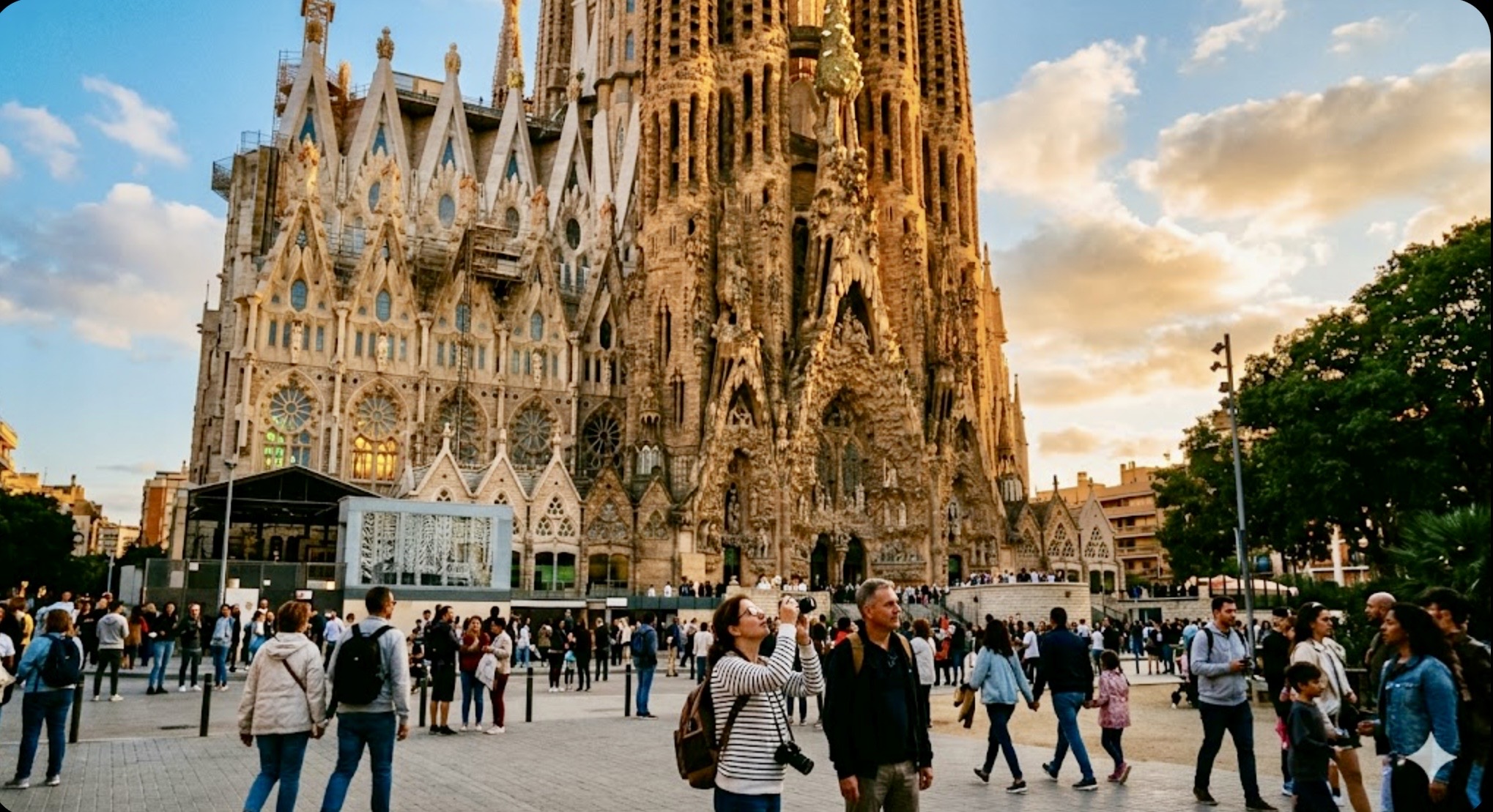
The Sagrada Família is the obvious starting point. Begun in 1882, still under construction, it is simultaneously the most visited monument in Spain and, improbably, still a working basilica where mass is celebrated. The exterior’s gothic spires are the images you recognize. The interior is what surprises: a forest of branching columns in green and gold stone, stained glass that fills the entire nave with warm amber light from the west and blue-green from the east, and a height that makes you physically aware of your smallness. I have walked into many extraordinary buildings in my career. The interior of the Sagrada Família is in a different category.
“The interior of the Sagrada Família is not a church you visit. It is a building you experience. Plan two hours. You will want them.”
Book your tickets several weeks in advance — the same-day queue is real, and the interior is worth the reservation. The tower lifts add another dimension if you’re comfortable with heights: the view from the Nativity façade tower over the Eixample grid and toward the sea is one of the better urban panoramas in Europe.
The other Gaudí sites worth your time: Casa Batlló on the Passeig de Gràcia (the interior is surreal; the rooftop is the money shot), Casa Milà — La Pedrera (the rooftop terrace at dusk, worth the admission for that alone), and Park Güell (arrive early, before the buses, or at golden hour when the crowds thin). Paláu Güell in the Raval is the least visited and one of the most underrated — an early Gaudí commission that shows you where his ambitions began.
The Neighborhoods
Understanding Barcelona means understanding its neighborhoods. They are not interchangeable. Where you base yourself determines not just your walking distances but the entire texture of your visit.
El Gòtic
The oldest part of the city — Roman foundations, medieval lanes, the Cathedral, the Pont del Bisbe bridge. Beautiful at 7am before the tours arrive, and again at night when the lanes clear. The Gothic Quarter is overrun during the day, genuinely lovely at its edges. Stay here if you want maximum history and don’t mind crowds. Avoid the most touristic blocks around Las Ramblas.
El Born
Immediately east of the Gothic Quarter, and a generation ahead of it in terms of dining and design. The Born market building — a 19th-century iron structure — sits above Roman ruins. The surrounding streets are dense with natural wine bars, independent shops, and some of the best pintxo spots in the city. This is the neighborhood I’d choose as a base. Walkable to everything; actual local life still visible.
L’Eixample
The 19th-century planned expansion of Barcelona, designed on a perfect grid with chamfered corners that create small octagonal intersections throughout. This is where the major Gaudí buildings live, and where much of the city’s luxury hotel stock is concentrated. Less atmospheric than the old city, but supremely practical. The Passeig de Gràcia is Barcelona’s answer to the Champs-Élysées — wide, architecturally distinguished, walkable.
Gràcia
North of the Eixample, technically an independent town absorbed into the city in the 19th century and still operating like one. Small squares, low-rise buildings, local produce markets, a population of artists and longterm residents who have resisted the full tourist transformation. Park Güell is at its northern edge. The evening bar scene here is calmer than the waterfront — this is where Barcelona goes when it wants to talk rather than be seen.
A City Photographed


Left to right: Sagrada Fàmilia interior · Barceloneta · La Boqueria market
The Table
Barcelona’s food scene is one of the great pleasures of European travel, and it operates on a different clock. Lunch is the main meal, served from 2pm to 4pm. Dinner starts at 9pm and runs until midnight. This is not a cultural affectation — it’s how the city eats, and if you fight it you’ll end up eating alone in tourist-targeted restaurants that open at 7pm for visitors who haven’t adjusted.
La Boqueria — the covered market on Las Ramblas — is worth one early morning visit to understand what the food culture is built on. Arrive before 10am to see it as a working market rather than a tourist attraction. The stalls near the back, away from the entrance, are where the actual grocers operate. The prepared food counters closest to Las Ramblas are primarily tourist-facing and priced accordingly.
For actual meals: the Mercat de Santa Caterina in the Born has a better food hall experience with less crowd pressure than Boqueria. The Bar del Pla on Carrer de la Montcada does the best patatas bravas I’ve encountered in the city. El Xampanyet, the cava bar tucked into the Born just off the Picasso Museum, has been open since 1929 and has no particular reason to modernize. Order the house cava and the anchovies and stay for a while.
If you eat one proper lunch in Barcelona, make it at a restaurant that still offers the menú del día — a fixed-price lunch of three courses with wine, bread, and water, typically €14–18. This is how Barcelona feeds itself at midday. It is the best value in European restaurant dining and almost completely invisible to travelers who don’t know to ask.
The Sea
Barcelona’s relationship with its coastline is unusual among great European cities: the beach was almost entirely rebuilt for the 1992 Olympics, which created a functional if slightly artificial waterfront that the city has gradually made its own. Barceloneta, the old fishermen’s quarter that sits between the old city and the sea, is the neighborhood that gives the coast its character.
The beach itself is functional and surprisingly good — wide, clean, well-served by transit, with the Barceloneta neighborhood and its narrow streets providing the human texture that keeps it from feeling like a resort. The chiringuitos (beach bars) along the sand are at their best in the hour before sunset, when the afternoon heat breaks and the light turns amber over the water.
The W Hotel marks the southern end of the Barceloneta beach and signals the transition to the Port Olímpic marina area. Walk north along the promenade instead — past the bronze fish sculpture by Frank Gehry, past the Hotel Arts, to the quieter stretches of beach that thin out as you move toward the Pobè area. This end of the coast is where families set up rather than day-trippers, and the difference is palpable.
When to Go
Barcelona operates year-round, but the timing question matters more here than in most cities because the crowds are genuinely disruptive at peak season.
September and early October are the right answer for most travelers. The summer heat is breaking, the sea is still warm, the August crowds of European vacationers have gone home, and the city is functioning normally again. This is Barcelona at its best.
May and June are good: warm but not oppressive, crowds building but not yet at summer peak. The city is alert and energetic in spring.
July and August: the Sagrada Família queues are longest, the beaches are packed, the restaurant kitchens are under maximum pressure, and daytime temperatures can exceed 35°C. It can be done, but you’ll work for every good experience.
November through February: quiet, cool (10–15°C), and the version of Barcelona that belongs to the people who live there. Some beach-adjacent venues are closed, but the museum hours extend, the restaurants are fully staffed and attentive, and the Sagrada Família can be experienced without fighting through the courtyard.
Practical Notes
- Transit: The T-Casual card (10 trips, €11.35) covers metro, bus, and the local rail network. Barcelona’s metro is excellent. Walking between the Gothic Quarter and the Born takes 10 minutes. Walking to the Sagrada Família from either takes 30–35 minutes; the metro is faster.
- Las Ramblas: Walk it once, early morning, for context. It is a historical pedestrian boulevard that has been entirely given over to tourist infrastructure. The pickpocketing rate here is among the highest in Europe; keep your valuables elsewhere. The city’s actual pedestrian life happens on the parallel streets.
- Tickets: The Sagrada Família requires advance booking, full stop. Casa Batlló and La Pedrera benefit from morning time slots. Park Güell’s ticketed zone is required April–October.
- Language: Barcelona is bilingual — Catalan and Spanish. Signs are in Catalan; people speak both. A greeting in Spanish will be answered in whichever language is more convenient for the speaker. Do not mistake Catalan for a dialect.
- Dinner timing: If a restaurant near a tourist site opens before 8:30pm for dinner, it is open for you specifically. Locals eat later. The kitchen becomes interesting after 9pm.
- Gratuity: Tipping is not expected in the way it is in the US. Rounding up or leaving a few euros on a cash payment at a bar is normal. A formal service charge is not.
Prefer a city journal approach? Barcelona: A City That Never Ends covers Gaudí, the neighborhoods, the table, and the sea — same GM voice, same standards, different format.
Looking for where to stay? Read the full Spain editorial → — Jay’s hotel-by-hotel breakdown of Barcelona and Madrid, with property picks at every budget.
Explore hotels, flights, and activities in Barcelona through TravelWyn’s Barcelona guide.
Tours & Experiences
Barcelona Tours via GetYourGuide
La Sagrada Famíra skip-the-line, Gothic Quarter walking tours, Montserrat day trips, Flamenco shows, and more — verified by millions of travelers. 8% commission supports this site.
Browse Barcelona Tours on GetYourGuide →More from the Hotel GM Picks series
Jay Jayyusi is the founder of TravelWyn and a Task Force General Manager with 30+ years in hospitality. He has worked across Europe and writes about travel, hotels, and the craft of staying somewhere well.


